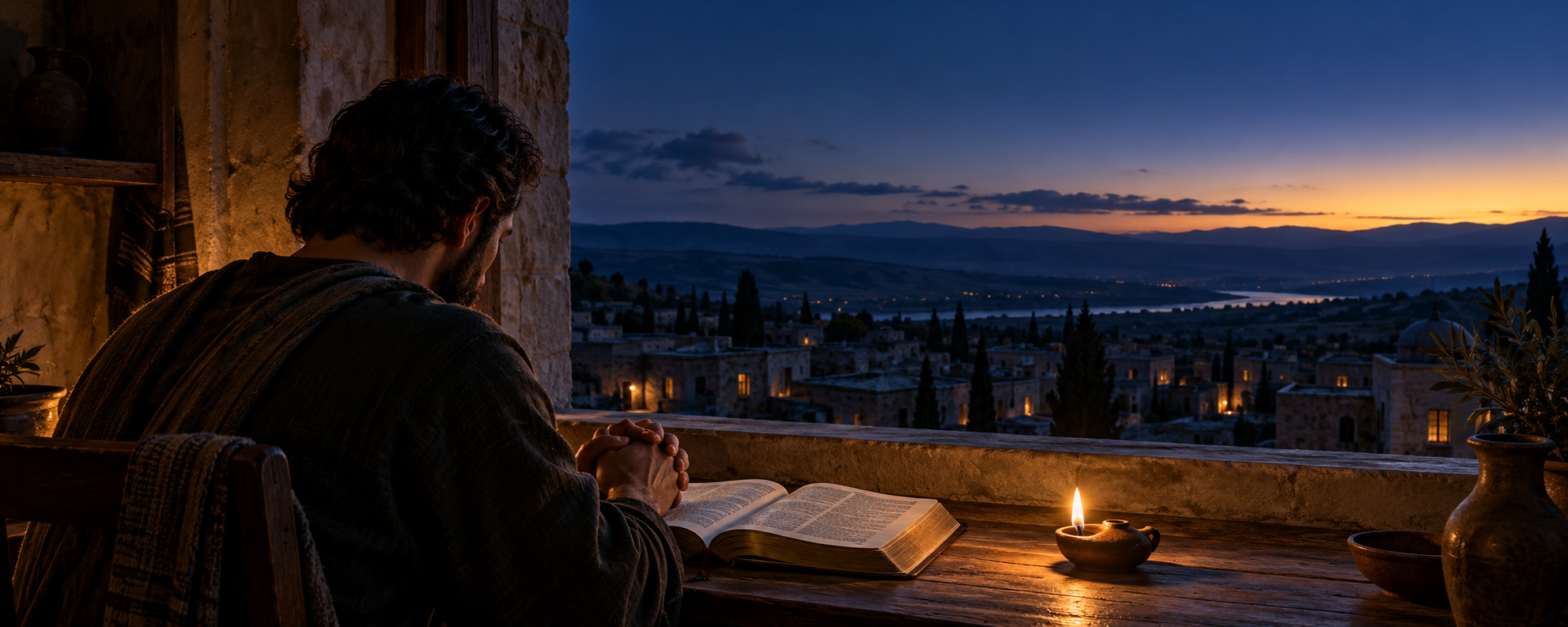
Throughout Scripture, the night became a place of remembrance, worship and earnest intercession. Discover what it means to stand watch in prayer, remain spiritually alert through dark seasons and faithfully look toward the coming dawn.
Night has a way of making burdens feel heavier.
The distractions of the day become quiet, but the mind does not always follow. Questions grow louder. Grief settles into the empty spaces. Somewhere, a family is keeping vigil beside a hospital bed. Someone is waiting for a phone call. Someone is fighting temptation, carrying fear or praying for a loved one who seems far from God.
Scripture does not pretend that darkness is easy. Yet again and again, it shows people turning the hours of darkness into a place of prayer.
The midnight hour is not spiritually powerful because of a number on the clock. God does not hear us more clearly at midnight than He does at midday. But the night can strip away noise, reveal what weighs upon the heart and invite us into undistracted communion with Him.
To stand watch is to remain prayerfully awake to God, attentive to the needs around us and faithful when others may not be able to pray for themselves.
Remembering God in the Night Watches
David wrote:
“On my bed I remember you; I think of you through the watches of the night.”
— Psalm 63:6
In the ancient world, the night was divided into watches—periods during which guards remained awake while others slept. David borrowed this language to describe sustained attention to God.
Psalm 63 was born in the wilderness. David was not writing from comfort. He was physically weary, spiritually thirsty and surrounded by uncertainty. Yet in the darkness, he deliberately remembered God.
Night prayer often begins there—not with a dramatic declaration, but with remembrance.
We remember who God has been. We remember the prayers He has already answered, the mercy that carried us before and the promises that remain true even when our circumstances are unclear.
Darkness narrows our vision. Remembrance widens it again.
Watchmen Who Give God No Rest
Through Isaiah, God said:
“I have posted watchmen on your walls, Jerusalem; they will never be silent day or night.”
— Isaiah 62:6
These watchmen were connected to God’s promised restoration of Jerusalem. They were appointed to remain attentive and to continually call upon the Lord until His purposes were fulfilled.
This passage does not mean that prayer controls God or forces Him to act. The watchmen were praying in agreement with promises God Himself had made. Their persistence was an expression of faith: they believed God’s word strongly enough to keep bringing it before Him.
Biblical intercession begins with God’s character and purposes. We do not stand on the wall to dictate an outcome. We stand there to seek Him, remember His promises and refuse to become indifferent.
A watchman notices what others may overlook. A praying watchman brings what they see before God.
They notice the person quietly withdrawing from community. They remember the family walking through grief. They pray for the church, the vulnerable, the lost, their community and those carrying responsibilities few people can see.
Standing watch means refusing to say, “That burden belongs to someone else.”
Jesus Prayed Through the Night
Luke tells us that Jesus went to a mountainside to pray and spent the night praying to God. When morning came, He called His disciples and chose twelve of them to be apostles (Luke 6:12–13).
Jesus’ night of prayer came before a significant decision and a new stage of ministry.
He did not pray because the Father was reluctant to guide Him. He withdrew from noise and remained in communion with the Father before choosing those who would walk closely with Him.
This gives us a pattern—not a rule that every important decision requires an all-night prayer meeting, but an invitation to give weighty matters more than hurried attention.
Some decisions should not be made between notifications. Some burdens cannot be faithfully carried in a rushed sentence on the way out the door. There are moments when love calls us to linger.
What Spiritual Vigilance Means
Spiritual alertness is not living in constant suspicion or looking for demons behind every difficulty. It is sober attentiveness to God, to truth, to our own hearts and to the needs of others.
Jesus repeatedly told His disciples to watch and pray. In Gethsemane, as the cross drew near, He urged them:
“Watch and pray so that you will not fall into temptation.”
— Matthew 26:41
They were physically present, but they struggled to remain spiritually awake.
We can do the same. We may be surrounded by suffering yet become numb to it. We may repeat familiar prayers without truly attending to God. We may become so exhausted by bad news that we stop believing prayer matters.
Watchfulness resists that numbness.
It asks:
*Lord, what needs prayer here?*
*Where am I becoming spiritually sleepy?*
*Who needs someone to stand with them?*
*What truth must I keep remembering?*
A watchful believer is not consumed by darkness. They remain aware of it while keeping their attention fixed upon Christ.
Does Prayer Turn Back Spiritual Darkness?
Prayer matters in the struggle against spiritual darkness, but it is important to say this carefully.
We do not overcome darkness through the strength, length or intensity of our prayers. Jesus Christ has already triumphed over sin, death and the powers of darkness through His cross and resurrection.
Prayer does not make Christ victorious. Prayer is one of the ways we live in, depend upon and bear witness to His victory.
When we pray, lies are confronted with truth. Fear is brought beneath the authority of God. Temptation is exposed. The oppressed are remembered. The weary receive strength. The Church is called back to faithfulness, and the gospel continues to advance.
In Acts 16, Paul and Silas prayed and sang hymns at midnight while imprisoned. Their bodies were confined, but their worship was not. God sent an earthquake, the prison doors opened and their chains came loose. Yet the story’s greatest wonder was not merely an escape. The jailer and his household heard the gospel and believed.
The darkness was answered with prayer, worship and faithful witness.
When the Night Is Not Literal
Not every night watch happens after sunset.
Some seasons feel like midnight even at noon. Grief, illness, persecution, uncertainty and prolonged waiting can make life feel dark. During those seasons, keeping watch means continuing to seek God when we cannot yet see the dawn.
It means praying when the answer is delayed.
It means holding hope for someone who has none left.
It means continuing to believe that God is working even when His work remains hidden.
The watchman does not create the sunrise. The watchman simply remains at their post because they know morning will come.
A Calling, Not a Competition
Some believers feel especially drawn to pray during the night. Others may occasionally wake with a person or situation strongly on their mind and choose to pray. This can become a beautiful act of intercession.
But Scripture does not command every Christian to regularly sacrifice sleep in order to prove spiritual devotion. Rest is also a gift from God, and our bodies have limits.
Night prayer should not become a competition, a source of pride or a measure by which we judge another person’s faith. Nor should every moment of wakefulness be treated as a secret spiritual message.
We can simply ask, “Lord, is there something You would have me pray about?” If nothing particular comes to mind, we may rest in His care.
The purpose of the watch is faithfulness, not exhaustion.
How to Keep a Prayer Watch
A prayer watch can be simple.
Begin by becoming still and acknowledging that God is present. Read a short passage of Scripture slowly. Allow God’s Word to shape the direction of your prayers.
Pray first for your own heart—that you would be honest, humble and attentive. Then bring before God the people, places and burdens He has placed upon you.
Pray for those who cannot pray for themselves. Pray for people working through the night, families keeping vigil, those in danger, those facing temptation and those who feel forgotten.
Leave room for silence. Intercession does not require constant speech.
Write down names or needs so that you can return to them. When possible, share the watch with other believers so that the burden does not rest on one person alone.
Finally, release each request into God’s hands. A watchman remains attentive, but does not pretend to be the Saviour.
Until the Morning Comes
The Bible’s story does not end in darkness.
Christ is the light the darkness cannot overcome. We pray through dark seasons because we know they are not permanent. We keep watch because God remains faithful. We intercede because love refuses to sleep through another person’s pain.
Perhaps your midnight hour is literal. Perhaps it is a season in which the way forward remains hidden.
Either way, you are not standing alone.
The God who watches over His people does not slumber or sleep. He is present in the silence, sovereign over the darkness and already Lord of the coming dawn.
Keep watch.
Keep praying.
Morning belongs to God.
A Prayer for the Night Watch
Father, make me faithful in the watches of the night and in every season that feels dark. Keep my heart awake to Your presence and attentive to the needs of others. Teach me to intercede without fear, pride or striving. When I cannot see what You are doing, help me remember who You are. Guard those who are vulnerable, strengthen those who are weary and bring the light of Christ into places of fear, temptation and despair. Help me remain at my post with hope until the morning comes. In Jesus’ name, amen.
The distractions of the day become quiet, but the mind does not always follow. Questions grow louder. Grief settles into the empty spaces. Somewhere, a family is keeping vigil beside a hospital bed. Someone is waiting for a phone call. Someone is fighting temptation, carrying fear or praying for a loved one who seems far from God.
Scripture does not pretend that darkness is easy. Yet again and again, it shows people turning the hours of darkness into a place of prayer.
The midnight hour is not spiritually powerful because of a number on the clock. God does not hear us more clearly at midnight than He does at midday. But the night can strip away noise, reveal what weighs upon the heart and invite us into undistracted communion with Him.
To stand watch is to remain prayerfully awake to God, attentive to the needs around us and faithful when others may not be able to pray for themselves.
Remembering God in the Night Watches
David wrote:
“On my bed I remember you; I think of you through the watches of the night.”
— Psalm 63:6
In the ancient world, the night was divided into watches—periods during which guards remained awake while others slept. David borrowed this language to describe sustained attention to God.
Psalm 63 was born in the wilderness. David was not writing from comfort. He was physically weary, spiritually thirsty and surrounded by uncertainty. Yet in the darkness, he deliberately remembered God.
Night prayer often begins there—not with a dramatic declaration, but with remembrance.
We remember who God has been. We remember the prayers He has already answered, the mercy that carried us before and the promises that remain true even when our circumstances are unclear.
Darkness narrows our vision. Remembrance widens it again.
Watchmen Who Give God No Rest
Through Isaiah, God said:
“I have posted watchmen on your walls, Jerusalem; they will never be silent day or night.”
— Isaiah 62:6
These watchmen were connected to God’s promised restoration of Jerusalem. They were appointed to remain attentive and to continually call upon the Lord until His purposes were fulfilled.
This passage does not mean that prayer controls God or forces Him to act. The watchmen were praying in agreement with promises God Himself had made. Their persistence was an expression of faith: they believed God’s word strongly enough to keep bringing it before Him.
Biblical intercession begins with God’s character and purposes. We do not stand on the wall to dictate an outcome. We stand there to seek Him, remember His promises and refuse to become indifferent.
A watchman notices what others may overlook. A praying watchman brings what they see before God.
They notice the person quietly withdrawing from community. They remember the family walking through grief. They pray for the church, the vulnerable, the lost, their community and those carrying responsibilities few people can see.
Standing watch means refusing to say, “That burden belongs to someone else.”
Jesus Prayed Through the Night
Luke tells us that Jesus went to a mountainside to pray and spent the night praying to God. When morning came, He called His disciples and chose twelve of them to be apostles (Luke 6:12–13).
Jesus’ night of prayer came before a significant decision and a new stage of ministry.
He did not pray because the Father was reluctant to guide Him. He withdrew from noise and remained in communion with the Father before choosing those who would walk closely with Him.
This gives us a pattern—not a rule that every important decision requires an all-night prayer meeting, but an invitation to give weighty matters more than hurried attention.
Some decisions should not be made between notifications. Some burdens cannot be faithfully carried in a rushed sentence on the way out the door. There are moments when love calls us to linger.
What Spiritual Vigilance Means
Spiritual alertness is not living in constant suspicion or looking for demons behind every difficulty. It is sober attentiveness to God, to truth, to our own hearts and to the needs of others.
Jesus repeatedly told His disciples to watch and pray. In Gethsemane, as the cross drew near, He urged them:
“Watch and pray so that you will not fall into temptation.”
— Matthew 26:41
They were physically present, but they struggled to remain spiritually awake.
We can do the same. We may be surrounded by suffering yet become numb to it. We may repeat familiar prayers without truly attending to God. We may become so exhausted by bad news that we stop believing prayer matters.
Watchfulness resists that numbness.
It asks:
*Lord, what needs prayer here?*
*Where am I becoming spiritually sleepy?*
*Who needs someone to stand with them?*
*What truth must I keep remembering?*
A watchful believer is not consumed by darkness. They remain aware of it while keeping their attention fixed upon Christ.
Does Prayer Turn Back Spiritual Darkness?
Prayer matters in the struggle against spiritual darkness, but it is important to say this carefully.
We do not overcome darkness through the strength, length or intensity of our prayers. Jesus Christ has already triumphed over sin, death and the powers of darkness through His cross and resurrection.
Prayer does not make Christ victorious. Prayer is one of the ways we live in, depend upon and bear witness to His victory.
When we pray, lies are confronted with truth. Fear is brought beneath the authority of God. Temptation is exposed. The oppressed are remembered. The weary receive strength. The Church is called back to faithfulness, and the gospel continues to advance.
In Acts 16, Paul and Silas prayed and sang hymns at midnight while imprisoned. Their bodies were confined, but their worship was not. God sent an earthquake, the prison doors opened and their chains came loose. Yet the story’s greatest wonder was not merely an escape. The jailer and his household heard the gospel and believed.
The darkness was answered with prayer, worship and faithful witness.
When the Night Is Not Literal
Not every night watch happens after sunset.
Some seasons feel like midnight even at noon. Grief, illness, persecution, uncertainty and prolonged waiting can make life feel dark. During those seasons, keeping watch means continuing to seek God when we cannot yet see the dawn.
It means praying when the answer is delayed.
It means holding hope for someone who has none left.
It means continuing to believe that God is working even when His work remains hidden.
The watchman does not create the sunrise. The watchman simply remains at their post because they know morning will come.
A Calling, Not a Competition
Some believers feel especially drawn to pray during the night. Others may occasionally wake with a person or situation strongly on their mind and choose to pray. This can become a beautiful act of intercession.
But Scripture does not command every Christian to regularly sacrifice sleep in order to prove spiritual devotion. Rest is also a gift from God, and our bodies have limits.
Night prayer should not become a competition, a source of pride or a measure by which we judge another person’s faith. Nor should every moment of wakefulness be treated as a secret spiritual message.
We can simply ask, “Lord, is there something You would have me pray about?” If nothing particular comes to mind, we may rest in His care.
The purpose of the watch is faithfulness, not exhaustion.
How to Keep a Prayer Watch
A prayer watch can be simple.
Begin by becoming still and acknowledging that God is present. Read a short passage of Scripture slowly. Allow God’s Word to shape the direction of your prayers.
Pray first for your own heart—that you would be honest, humble and attentive. Then bring before God the people, places and burdens He has placed upon you.
Pray for those who cannot pray for themselves. Pray for people working through the night, families keeping vigil, those in danger, those facing temptation and those who feel forgotten.
Leave room for silence. Intercession does not require constant speech.
Write down names or needs so that you can return to them. When possible, share the watch with other believers so that the burden does not rest on one person alone.
Finally, release each request into God’s hands. A watchman remains attentive, but does not pretend to be the Saviour.
Until the Morning Comes
The Bible’s story does not end in darkness.
Christ is the light the darkness cannot overcome. We pray through dark seasons because we know they are not permanent. We keep watch because God remains faithful. We intercede because love refuses to sleep through another person’s pain.
Perhaps your midnight hour is literal. Perhaps it is a season in which the way forward remains hidden.
Either way, you are not standing alone.
The God who watches over His people does not slumber or sleep. He is present in the silence, sovereign over the darkness and already Lord of the coming dawn.
Keep watch.
Keep praying.
Morning belongs to God.
A Prayer for the Night Watch
Father, make me faithful in the watches of the night and in every season that feels dark. Keep my heart awake to Your presence and attentive to the needs of others. Teach me to intercede without fear, pride or striving. When I cannot see what You are doing, help me remember who You are. Guard those who are vulnerable, strengthen those who are weary and bring the light of Christ into places of fear, temptation and despair. Help me remain at my post with hope until the morning comes. In Jesus’ name, amen.